Wednesday, December 1, 2021

Solomon Islands District - 10th Anniversary


Special Report written by Major Robert Evans, District Leader...

General Albert Osborn, former international leader of The Salvation Army, wrote a hymn acknowledging, “What a work the Lord has done, by His saving grace,” which rings true today as The Salvation Army has just celebrated ten grace-filled years of mission and ministry in the Solomon Islands.

The 10th Anniversary weekend kicked off on Friday, 19th November with Honiara Corps cultural dancers and timbrelists leading a procession of the District Officers, Area Officers and Church Leaders into the Opening Program. The evening commenced with video greetings from Colonels Garth and Patti Niemand, Territorial Leaders of the Papua New Guinea & Solomon Islands Territory. Their words of encouragement set the tone for the weekend, as the Solomon Islands District reflected back on the past 10 years with gratitude and looked forward to the next 10 years with great anticipation, echoing the refrain of General Osborn’s hymn, “Greater things! Greater things! Give us faith, O Lord, we pray, faith for greater things.” Pastor Jimmy Vasula from Gateway CRC Church, who hosted the anniversary weekend, was the guest speaker for the Opening Program. He congratulated The Salvation Army for ten faithful years of mission and ministry in the Solomon Islands and challenged the local Salvationists to go on to the ‘next level’.

The weekend proceeded with two workshops on Saturday morning where Major Vanessa introduced the World Vision ‘A Good Life for All Boys & Girls’ Sunday School resource and Major Robert launched the Territorial Strategic Plan. After lunch an Open Air and March of Witness with the Royal Solomon Islands Police Brass Band provided an amazing display of over 100 Salvationists marching from Henderson Police Station back to the venue for a brass band concert, that included the Honiara Corps Brass Band. The evening featured the youth of the District who led a powerful evening of worship and items from each of the church youth groups, including the enrollment of 16 new Junior Soldiers. Sunday morning commenced with a combined worship service with the CRC church hosts, followed by a celebration feast of pork, chicken, kasava and taro that was cooked overnight on a traditional ‘motu.’ After lunch the main Worship Service included the enrolment of six Soldiers, recognition of two new Churches, and the warranting of six non-commissioned Officers, with a video message by the Territorial Commander.


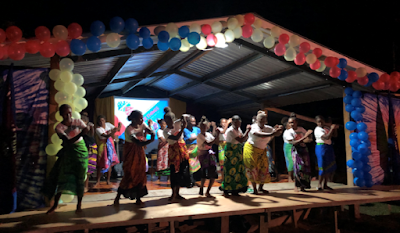
The finale for the weekend was a spectacular Mission & Cultural Celebration that was opened by a video greeting from international leaders General Brian and Commissioner Rosalie Peddle, along with other video greetings from several previous Territorial and District leaders. The evening was also attended by a number of community and business leaders who are great supporters of The Salvation Army. Major Robert presented an overview of the mission activity throughout the District, after which, each church presented cultural items representing their villages and provinces. A highlight of the evening was the unveiling of a commissioned artwork portraying The Salvation Army flag in an abstract Solomon Island style


The theme for the weekend ‘Greater Things’ was creatively manifested through song and dance, leaving no doubt that the best is yet to come!


Special Report written by Major Vanessa Evans, District Leader...

2021 theme for the Solomon Islands District was “Greater Things.”  Jesus said "You believe because I told you I saw you under the fig tree. You will see greater things than that" (John 1:50). To help with this theme one of the songs that became a bit of an anthem particularly at Honiara Corps was Chris Tomlin’s God of this City. The chorus says, ‘Greater things have yet to come and greater things are still to be done in this city, Greater things have yet to come and greater things are still to be done here.’ This song was not only sung throughout the year but was also the theme song for our 10th Anniversary weekend celebration. We wanted to celebrate all that had happened over the last 10 years as well as holding on to the promise that we would see greater things in the future.


Friday night was our opening program and what a program that was! The District Leaders, Corps Officers and Village Church Leaders were led into the CRC Gateway church by traditional dancers from the Honiara Corps, supported by the Honiara Timbrel Brigade. There was lots of singing, dancing, messages from the PNGSI Territorial Leaders Colonels Garth & Patti Niemand, as well as greetings from our 9 church leaders. We were also blessed to have a Historic Video Presentation that reminded the Solomon Islands that they “Were always on His mind.” This presentation showed some wonderful historic pictures of The Salvation Army being connected to the Solomon Islands as far back as 1894. Pastor Jimmy from CRC Gateway was our guest speaker. Pastor Jimmy and his wife Mama Mary are great friends and supporters of ours and allowed us to use their beautiful facilities for our Anniversary weekend.


Saturday was a full day. There were two workshops that were held; the first was on the Sunday School curriculum from World Vision called ‘A Good Life for Boys & Girls’. I have had the privilege of being a part of the working group to put this together. The second workshop was led by Rob who spoke on the Territorial Strategic Plan - ‘Restore, Renew, Rebuild’ and how each of our congregations can use this theme next year as this will become our overall theme for the District. Saturday afternoon consisted of a March of Witness along the main road of Henderson with the assistance of the RSIPF band, which then led to a Brass Band concert. It was great to see our band and the RSIPF band play together and we thank the RSIPF for their support over the last 3 years. Saturday night was the youth meeting which was amazing. 16 Junior Soldiers were enrolled and I preached on how to Stand Out From The Crowd (1 Chronicles 4:9-10). I was humbled and amazed at the work of the Holy Spirit as 51 adults, youth & children responded to God’s Word. Sunday afternoon was a great celebration of the future with the enrolments of 6 new soldiers and the warranting of our new Auxiliary Captains and Envoys. Sunday evening was again another amazing celebration of culture and mission as we were led in by the Gateway Corps traditional dancers. Each corps and church fellowship presented items throughout the night with messages from previous leaders. It was great to see our many friends from different networks that we have developed over the last 4 years join in the celebrations. The other highlight of the evening was the unveiling of the Commissioned Artwork “God’s Light in the Darkness” by Riaz Haikiu Maninga.

Greater things are yet to come and greater things are still to be done in this country of Solomon Islands.

Sunday, November 14, 2021

Spiritual Formation Journal - Chapter 4

Master of Transformational Development

Doing Theology in the Context of Poverty & Injustice


I must confess that after I read the unit guide for this semester, I approached the subject with a degree of reservation. The minor essay question asking to “Identify a key point of tension or difference between your ‘inherited theology’ and your emerging theology that is evolving in response to the challenges posed by your vocational calling” evoked a tension in my theological sensibilities. I struggled to connect with the notion of an ‘emerging theology that is evolving’ in response to my ‘experiences’, rather than God’s revelation. From the outset, I found my theological roots (The Salvation Army comes from a Wesleyan Methodist theological tradition) reacting to any thought that human experience is an equal or greater authority in forming a contextual theology.

I come from a theological position that there are core beliefs about God’ as revealed in Scripture, that are unchanging regardless of culture, time or experiences. Obvious examples include: Authority of the Scriptures, Monotheistic God, Trinitarian God, Divine & Human natures of Christ, Salvation through Christ alone, etc. So, to encounter Stephen Bevans as the first reading for the semester, who places experience above revelation, only fuelled my reservations about the subject. The author’s explanation of ‘contextual theology’ made me incredibly nervous, especially if the "experience of the present" is at odds morally, ethically or spiritually with the "experience of the past". I wrestled with the question, “If there is space for “self-theologising” to be included in Henry Venn’s 3-Selves model for indigenous churches, then, how do we genuinely invite and include a “new agenda, new methods, new voices, new dialogue” (Bevans, 2009, p. 13) without losing biblical integrity in arriving at and applying a contextual theology?

However, throughout the reading period the breadth of readings and diversity of thought on the subject balanced Bevans’ views with an understanding of contextual theology which “leads us to the realization that the fundamental transformation that must take place is not the transformation of an ancient message into a contemporary meaning but rather the transformation of our lives by means of God’s Word” (Segura-Guzman, 2010, p. 130). The other authors and our cohort discussions enabled me to engage with contextual theology, not as a threat to biblical truth, but as an endeavour to allow God’s voice to speak through other cultural contexts in a way that will provide a contextual revelation from within their respective cultures and life situations. I was reminded of previous undergraduate study where I encountered authors like Clark Pinnock who affirmed, “We do not affirm the possibility of God’s revealing himself outside Christianity begrudgingly - we welcome it! Not only does such a possibility suggest bridges in other cultures to enhance mission, but it also allows us to hear the word of God from others and deepens our own understanding of revelation” (Pinnock, 2015, p. 208).

The subject also provided an excellent reference point for retrospective reflection on interfaith dialogue I had with leaders from the Ahmadiyyah Muslim Community and Afghan Muslim asylum seekers in my previous appointment. It has given me new language and fresh understanding for these conversations where I felt theologically way out of my depth at the time. It also has affirmed, that despite my inadequacies, the Holy Spirit was clearly present and guiding this dialogue and I was simply joining in on a conversation that had already begun.

In my current vocational context, navigating a course for The Salvation Army as still a relatively new mission in the Solomon Islands has been a process of discovering what this movement needs to look like in this cultural context. The major essay has allowed me to apply the learning of this semester into a culturally specific challenge that could open the door for future mission and ministry for The Salvation Army by engaging in critical theological reflection and application. It has contributed significantly to conversations I am currently having with local community and church leaders and I believe will provide a useful paper, not only for the Solomon Islands, but also for The Salvation Army in Papua New Guinea. Learning how to ‘do theology in the context of poverty and injustice’ in this context could not be any more relevant and timely!

Sunday, August 1, 2021

Solomon Islands District - Youth Mission Trip

Special Report written by Hudson Kwale...

The youth program was held at Rauai Family Worship Centre in West Kwara’ae, Malaita on the 2nd to the 4th July 2021.


The name for the program was “New Things” and the Scripture was Isaiah 43:18-19. Our youth should be focused on new things that the Word of God has for us in the future, which determines our destination. It was really a weekend of blessing for our families at Rauai Village.

We experienced that our Lord has given us a chance to learn from the youth at Gateway Corps and Honiara Corps as well. We come to realize now that God has been with us throughout the years of our past life. However, we are now focusing on God’s words to reward our future. We really enjoy and learn a lot during the weekend from what the other youth put on show. It was a challenge for us.

The drama displayed to us a reality of lifestyle of today. The program helped us to be strong and caused us to put our focus on God to live as Christ Jesus, the One who hold the future for us despite our wasted past life. The program helps our spiritual life grow up one more step and thank God for keeping us to the maturity of life.

We would like to take this opportunity to thank God for His presence with us during the special weekend. We will always remember the youth mission team in our life for what they have done as we venture into the future.

We pray that God will allow us another opportunity to come together in the future. This is for our youth to feed from the Word of God. Once again, thank you very much. Looking forward to meet your youth group again in the future. God bless!


YOUTH TESTIMONIES...


Jesmah Taka (Rauai Youth Leader)

To define the theme “Do not dwell on the past” which means youth do not hold onto what had happened on the past in their lives, but to look forward to our future for new things that God will provide for us.  During the youth program held from Friday, 2nd July to Sunday, 4th July 2021 at Rauai village, the youths were really blessed and got spiritual food from our mighty man of God Pastor Wency. It also helps Rauai youth to move up next level in their lives. We experience from many good things from different youths that they came to attend the youth program with us. We do learn from them from their characters and actions that they display during the youth program.  To conclude my brief story, I would like challenge Rauai youth to follow the examples that Gateway youth from Honiara has shown us. Rauai youth is now blessed and can now feel the blessing and presence of God after the program and onward.

Jeffrey Kalia (Honiara Youth)

The program was mandated or set on Friday 2nd July 2021. We departed from Honiara at 1:00 pm in the afternoon to Auki, Malaita Province. There were 36 youth members on board in the ship to Malaita. Now we were finally grounded in Auki wharf at 5:00 pm and also board the truck on the same port. The youth arrived in Rauai village at 8:00 pm where the program was held and also location of The Salvation Army church.  On the same Friday night the program was started at 9:00 pm, and I know that there are four (4) youth groups that gathered for the program. They are as follows: Honiara youth, Gateway youth, CRC youth and the hosting youth which known as RAUAI youth. These are youths that came together for the program. During the youth camp I can see that God has done great and mighty things in the life of the young youths even the people of Rauai village and surrounding areas are also blessed by God’s Word at the camp. Indeed, that’s how you can see intervention of the Holy Spirit is in this young people on the Sunday worship at Rauai, the pastors, women and the youths are carrying; even I was filled with the presence and power of the almighty God.  Finally, but not the least, God is at work and moving power of the Holy Spirit is changing and transforming the three ex-prisoners of Rauai young men, they are no longer under the power of darkness or evil, but they are now, the sons of God and we as youth, should give honor, glory and praise back to our almighty God for what he has done in the life of these young men. Therefore, greater things are yet to come! This is the beginning of our journey with our God with more to come. God, you are great and more than enough to us. But I would like to leave one verse in the Scripture, it said ‘always give thanks to God because his love endures forever.’

Gideon Sency (Honiara Youth)

For me the youth mission to Rauai was a blessing. I have experienced God’s power moving mightily and done great things in the lives of all that attended the weekend camp. As an individual I have felt the anointing of God was upon all the young youths during our time. God transformed lives and set a new beginning for people in Rauai to abide in. Under our youth theme we carried to Rauai NEW THINGS — ”See, I am doing a new thing! Now it springs up; do you not perceive it? I am making a way in the desert and streams in the wasteland” (Isaiah 43:19).  God fulfilled His promise by making a new thing in Rauai and I see His mighty hand moving and touching the lives of each person that attended our youth camp. Souls were saved, relationships restored, and covenants were made with God.  For me, I am very happy and blessed because everything that God prepared in me for the mission. I was able to share with everyone that attend on that weekend camp and seen positive feedback which I know it does impact lives of individuals that join our weekend fellowship. To God be the glory for all the marvelous things that he has done.

Solomon Keniruahia (Honiara Youth)

Mission to Rauai was a really great opportunity for us to experience the power of the Holy Spirit and the manifestation of His Holy Spirit upon all young people of Rauai, Honaira and Gateway.  During this mission, we got a lot of experience with the young youths of Rauai, how God does transform their life from darkness to light. In addition, some of these young youths are great rascal boys, but God change them and now they have a testimony to share.  “Therefore, go and make disciples of all nations, baptizing them in the name of the Father and of the Son and of the Holy Spirit, and teaching them to obey everything I have commanded you, and surely I am with you always, to the very end of the age” (Matthew 28:19-20).  Firstly, to God be the glory, great things He has done. Through this mission God really touched my life and I’ve seen the mighty move of God in this mission to Rauai.  Secondly, young people of Rauai are really a great testimony for the people in and around Solomon Islands. God really works in their life and transforming their life and through our life they have seen and have more courage to have God in their life.  Lastly, but not the least, I just want to give all the glory and honour back to our mighty God for His provision, protection and blessing in this mission.


Regina Akwasitaloa (Gateway Youth)

The program was very good. It was well organised and we really enjoyed our time on the weekend. Physically the environment was good, which we enjoyed our time in sharing with other youths at Rauai. And spiritually the program really impacts great things in our lives!  As the theme ‘New Things’ in Isaiah 43:19-20 and the sessions organised for the weekend were successful, which we really appreciate the sermon from the servants of the Lord. Their main emphasis was for us to watch for the great things that God is going to do in our lives, rather than dwelling in the past. So, we really blessed by the Word of God throughout the weekend.  In addition to that the prayer chain organised was also successful, which throughout Saturday night we prayed continuously until morning. This brought great impact in the lives of the youths as well.  And during Sunday night, which was our social night, it was a great time where every youth really enjoyed the items presented from each youth. As from the Gateway Youth we really enjoyed our time on the weekend. We were really blessed with the Word of God through the changes that we experienced in our lives and it’s a blessing for us in our journey with our God. So, the youth program was successful. God bless us all.


Saturday, May 22, 2021

Spiritual Formation Journal - Chapter 3

Master of Transformational Development

Economics, Development & Human Flourishing


One of the biblical themes interwoven throughout this semester is the Hebrew idea of ‘shalom’ that depicts a state of holistic well-being. Studying the extent to which modern economic systems and structures contribute to a state of shalom has been a new challenge for me as I have reflected on the impact of our DME Coconut Oil Plant and the recent diplomatic switch from Taiwan to China in Solomon Islands. From the micro to the macro, it has been an interesting journey considering the impact of ‘development’ or lack of development on the well-being of communities from within my cultural context.

The Salvation Army has a long history of alleviating human suffering by demonstrating the love of Jesus Christ in practical ways. It is this mission intent that drives our social enterprise at one of our remote village churches in an endeavour to raise the standard of living and generate a sustainable income to resource our mission in the Solomon Islands. However, a quote from the reading “Reclaiming our Future: The Vision of Jubilee” has challenged the scope of my mission intentions to consider the space of shalom from another cultural perspective.

“Throughout the Torah and the economic teachings of Jesus, shalom is valued as more important to human happiness than a constantly rising standard of living” (Goudzwaard, p 183).

Remote villages have a unique rhythm of life that incorporates social and cultural values that are more centred upon maintaining a complex network of relationships than facilitating production and profitability. These relationships define daily routines, use of land and livelihood activities. To an outsider, these relationships may appear to get in the way of development when significant social and cultural events take precedence over everything else. For a task and results orientated person like me, this is something I can easily misinterpret as a cultural weakness when relationally driven disruptions compromise development initiatives. But are these ‘disruptions’ the actual point of development? Is development the servant or the master? Who defines what development looks like and its ultimate purpose? How does development promote shalom in village life? These are just some of the questions I have been pondering this semester.

I have visited a number of villages over the past three years and each time has been something of a soul-restoring experience. There is a simplicity and synergy in the rhythm of village life that reconnects you with what really matters. Yet, I find myself frustrated by the very thing that rejuvenates me. Despite the organic beauty, my cultural conditioning still sees a deficit in village life that appears to limit the development possibilities that could improve living conditions, provide education and create employment opportunities. How does one respond to such a tension? I can push harder to try and manufacture a state of shalom as a cultural outsider or I can sit with the tension long enough to discover what a state of shalom looks like for cultural insiders. I suspect this kind of relational enquiry would go a long way to answer the questions I have been pondering about the nature of development in a Solomon Islands village context. I also suspect that it may even reframe my own sense of well-being to be a little less result driven and a little more relationship orientated.

When Jesus said, “I have come that they may have life, and have it to the full” (John 10:10), He did so knowing what fullness of life looks like in a Kingdom culture, despite the prevailing Greco-Roman culture of His day. His sense of shalom was not defined by the dominant cultures but cast a counter-cultural vision for “a way of life that is best of all” (1 Corinthians 12:31b, NLT). Navigating the space between two cultures as Christ followers challenges us to assume a posture of humility to look beyond our own cultural ways to discover a revelation of ‘Christ in culture’ (Niebuhr 1951) to experience a deeper sense of shalom as fellow citizens of the Kingdom of God. Translating this into my role as the District Officer of The Salvation Army in the Solomon Islands invites a different approach to development. It opens the door to a mutual exploration of social enterprises and other mission endeavours that seek to find what a Kingdom-orientated fullness of life might look like in specific cultural contexts. Guiding a community towards a clear picture of a preferred reality would provide a basis for transformational development where success is measured by the degree to which it contributes to human flourishing in the village.

Monday, November 9, 2020

Spiritual Formation Journal - Chapter 2

Master of Transformational Development

Biblical Justice, Human Rights & Advocacy


At the beginning of this year, The Salvation Army began operating a DME (Direct Micro Expelling) Coconut Oil Plant at one of our churches in North Malaita to provide local jobs in the surrounding villages and generate a sustainable income to fund our mission in the Solomon Islands. While setting up this project, I encountered a number of challenges along the way with the ‘here and now’ mindset of local opportunists attempting to exploit money out of The Salvation Army during the construction of the plant. After months of perseverance and strong leadership, we were up and running. Then in July, I received a phone call to say that our generator had been stolen from the plant by some disgruntled workers who felt they weren’t being paid enough money for their work. While trying to retrieve our generator from the known thieves, they extorted $2,500 SBD from the plant manager for its return. Dealing with this matter at the beginning of the semester was an interesting alignment of circumstances, given the subject matter I was studying at the same time as responding to this situation.

My indignation at the initial theft and subsequent extortion evoked a reaction that leant more towards a form of ‘retributive justice’ than ‘restorative justice’ with little tolerance shown for the cultural thinking driving this behaviour. I was determined to ‘lay down the law’ (so to speak) about what was acceptable behaviour at the plant, which included an uncompromising declaration that the boys responsible would never work for The Salvation Army again, even if the money they took was repaid. The motive behind this hard-line was intended to challenge cultural thinking that has a long history of sabotaging development in North Malaita and to prevent similar attitudes from disrupting the operation of our social enterprise and mission in the future. However, during my follow-up visit to the plant in October my position on handling this matter began to soften after all the reading I had being doing about biblical justice. In particular, during the long journey to North Malaita, I began reading “Compassionate Justice” by Christopher D Marshall, which deeply challenged me with a vision of restorative justice. Marshall’s brilliant exposition of the parable of the Good Samaritan exposed a legalistic spirit within me and caused me to examine who really is my neighbour in the context of this situation. His lens of compassion broadened my expectations of restoration to be more than the recovery of stolen money and the resumption of production, but also a pathway of restoration for those who had wronged the community.

Marshall wrote, “If it is to flourish, then, restorative justice must be anchored in alternative “communities of value,” that is, in communities of people who accord the highest importance to the values of mutual care and accountability, honesty and compassion, confession and forgiveness, and peacemaking” (Marshall 2012, loc. 283). The values highlighted in this statement, which are at the heart of the ethos and mission of The Salvation Army, are better achieved when we “administer true justice; show mercy and compassion to one another” (Zechariah 5:9). This change of posture and pathway of restoration led to a powerful moment on my final night in the village when the boys responsible for the theft approached me one by one to apologise for their actions, after making a commitment to repay the money they stole from the plant.

This situation was not only a significant leadership challenge but a confronting spiritual challenge for me as my investigation and handling of the theft had turned inward to self-examination of my own sense of justice and righteousness. Initially, my compassion and desire for justice centred on those who had been wronged by having their source of income disrupted, which included both the village and The Salvation Army. By extending to the offenders the same compassion and restorative justice my response was reorientated more towards grace than legalism. My reorientated response also had an impact on the local church leaders, who were caught in the tension between their feelings of anger and shame towards the behaviour of the boys and their sense of responsibility for them as members of their community. Culturally, retributive justice is normal with ‘compensation’ being the Solomon Islands way to right wrongs. Community reconciliation only ever occurs after the payment of compensation, which can include cash, shell money, fresh produce and pigs. While seeking compensation beyond the return of what was stolen was never a consideration in my dealing with this matter, the offer of restoration with no demand for compensation was a powerful counter-cultural experience for this church. Who knows, maybe my personal transformation in this space may cast a vision for community transformation in North Malaita?

Wednesday, July 1, 2020

Solomon Islands District - Cyclone Harold Disaster Relief

On the 1st April 2020, a tropical low formed off the east coast of PNG and was classified as a tropical cyclone over Solomon Islands waters the next day. As tropical Cyclone Harold passed by Gaudalcanal Province it caused significant damage along the coastline to low-lying communities. In Honiara, strong winds damaged properties along the seafront and heavy rain flooded food crops planted along riverbanks.


One of the communities impacted by Cyclone Harold was Burns Creek, a Settlement in East Honiara where the Honiara Corps Officers reside. Burns Creek is a very vulnerable community with a history of social unrest and is a known hot spot for crime. When the community leaders from Burns Creek approached The Salvation Army for assistance, there was a feeling of helplessness and desperation driving their request. The community leaders were deeply concerned about food security and the potential for illegal activity to emerge out of concern for how their people were going to feed their families. This concern was exacerbated by the impact of the COVID-19 State of Public Emergency that shut down satellite markets around Honiara.

At the time of receiving this request, I was contacted by a colleague in Tasmania who was approached by a humanitarian organization called ‘The Obed Centre’ that had raised some money for Cyclone Harold victims. While discussing the potential allocation of these funds with The Salvation Army International Emergency Services (IES), I was made aware of the Rapid Response Grant that could also help with this request for assistance. After navigating the application process we were able to offer a substantial amount of relief to the Burns Creek leaders, which would support 790 families across 16 communities. Given the social concerns surrounding this crisis in Burns Creek, I approached the RSIPF National Crime Prevention Department (NCPD) and invited them to partner with us in the distribution of our disaster relief. This partnership provided very generous support with transportation through the use of two 3 tonne trucks and the opportunity for the RSIPF to conduct crime prevention talks alongside our SAES personnel.

Through the donation received from ‘The Obed Centre’, we were able to purchase 3,500 cassava stems from local farmers to help replace lost food crops. The funds from the IES Rapid Response Grant enabled us to purchase enough rice and tuna to feed the 790 families for three weeks while they replanted their gardens, with the generous support of Soltuna who donated 100 cartons of tuna and Solrice who donated two pallets of rice towards our relief strategy. Starting on Tuesday, 16th June, our SAES team, together with the NCPD, distributed a weekly allocation of rice and tuna to each community in Burns Creek for the three week period. The community response was quite overwhelming, with a number of very kind expressions of appreciation received by our team from grateful community leaders. The opportunity to work alongside the NCPD was a real blessing that built on the relationship we established with the RSIPF during the National General Election last year. This partnership had a real impact on those who normally see the police as the enemy in their law enforcement role. Instead, they saw them working alongside a church in a community service role that genuinely cared for their well-being.

This disaster relief program provided our SAES volunteers with another opportunity to demonstrate a practical expression of Christ’s love at a time of need. Our volunteers worked hard and enthusiastically engaged with this community in a way that has laid the foundation for future mission and ministry opportunities. In fact, during our last week of distribution, one community leader pointed out a section of his land saying he would like to build a church for The Salvation Army to commence services alongside his home. This practical expression of faith had a powerful impact on each community and church we visited in Burns Creek, as our assistance was given without discrimination or expectation of anything in return. We were simply happy to bless these people regardless of their church affiliation. Any future ministry that emerges will do so naturally and will be pursued in relationship with the other churches already active in Burns Creek.

We are very grateful to the IES for their funding, The Obed Centre for their donation, Solrice and Soltuna for their generous support and to the RSIPF for their partnership. I also want to acknowledge Envoy Wency Ramo’oroa for his liaison and coordination role with community leaders.

Wednesday, May 13, 2020

Spiritual Formation Journal - Chapter 1

Master of Transformational Development

Climate Change, Justice & Sustainability


Since December 2017, together with my wife Vanessa, we have been serving in the Solomon Islands as the District Officers in charge of The Salvation Army. During this time I have been on a journey of learning and discovery that has challenged my cultural values, strengthened my faith and opened extraordinary opportunities for mission.

The Solomon Islands is a country consisting of over 900 islands and a population of around 650,000 people with 92% professing a Christian faith. Christian values are clearly evident in every area of life with prayer and worship being central activities, not only in the churches but also in the public and political arenas. Every public meeting or event I attend, secular and sacred, is opened in prayer. Every village has a church that is central to community life and pastors hold more influence among indigenous people than politicians. In this context, being a Christian leader with responsibilities in both ecclesial and community work has a very different feel to Australia. As a Salvation Army Officer in Australia, when networking among secular organisations I encounter polarised responses to my ministry as a church pastor and my mission as a community welfare worker. Government, business and community leaders are more than happy to support our community work, but shy away from anything related to the church. This is a challenging space when your social and spiritual mission is integrated. However, Solomon Islands offers a very different space that enables me to freely interact with indigenous leaders who see Christian faith as an integral part of life without the dualism imposed by Australian secular culture. In fact, I have found that the integration of the spiritual and social mission of The Salvation Army, often expressed as ‘heart to God, hand to man’, resonates strongly with many Solomon Islanders who want the church to be more than a worshipping community. While I have never been shy in sharing my faith, there is a freedom of expression here that is liberating when interacting with people of influence and seeking their support for our ‘whole’ mission.

Yet, underneath this hyper-spiritual environment that projects a façade of Christendom, is a deeply entrenched culture of corruption, along with multi-layers of social evils that strains the credibility of this Christian nation in the eyes of international observers. Whether it is domestic violence, gender injustice or environmental degradation, the lack of alignment between faith and life gives false witness to the Christ this nation serves. Therefore, networking beyond religious indigenous leaders with secular expats and international NGO’s presents a number of faith challenges. On one hand there is a growing recognition that working with churches is essential to effective program implementation, on the other hand they look upon Christianity as ineffective, superstitious and even destructive. I get a sense from a number of external agencies that churches are tolerated as a means to an ends rather than an actual vehicle of community transformation. I have always held to the view that “the local church is the hope of the world” (Bill Hybels), in so far as it is the manifestation of Christ’s mission today. Regrettably, external observers do not see this manifestation of Christ in ways that brings hope and healing to a nation crippled by its own form of dualism that contradicts any aspiration of integrated mission. As I interact socially with High Commission, NGO, AFP, and ADF personnel, I am confronted with scepticism and resistance because of the stark incongruity of belief and behaviour. Fortunately, their respect for The Salvation Army allows me to engage in dialogue that ventures into this contentious faith space. I was recently introduced to the new Defence Advisor for South West Pacific, whose opening greeting to me was, “I’m not interested in your religion. As long as you understand that, we’ll get along fine.” I discovered that his rejection of anything ‘religious’ comes from years of military service where he has seen horrendous things done by people who profess faith in God or Allah. This includes having previously served in the Solomon Islands during the ‘Tensions’ where civil and ethnic unrest brought down the government and led to a period of total lawlessness in this Christian nation.

I see my challenge and role in this space including discipling indigenous Salvation Army leaders in Holiness so that their faith and life intersect in a way that transforms their worship from singing nice songs on Sunday, to living Christlike on Monday. And casting a transforming vision of Christianity to external networks that demonstrates how integrating faith into community life can bring belief and behaviour into alignment so that kingdom values transcend cultural values. This begins with an honest and humble acknowledgment of the current state of faith and culture by local Christian leaders and a call to lament and repentance for what has previously been done in Christ’s name. The Salvation Army is a relatively new church movement in this country with an international reputation that uniquely places us to respond to these faith challenges.