Wednesday, May 13, 2020

Spiritual Formation Journal - Chapter 1

Master of Transformational Development

Climate Change, Justice & Sustainability


Since December 2017, together with my wife Vanessa, we have been serving in the Solomon Islands as the District Officers in charge of The Salvation Army. During this time I have been on a journey of learning and discovery that has challenged my cultural values, strengthened my faith and opened extraordinary opportunities for mission.

The Solomon Islands is a country consisting of over 900 islands and a population of around 650,000 people with 92% professing a Christian faith. Christian values are clearly evident in every area of life with prayer and worship being central activities, not only in the churches but also in the public and political arenas. Every public meeting or event I attend, secular and sacred, is opened in prayer. Every village has a church that is central to community life and pastors hold more influence among indigenous people than politicians. In this context, being a Christian leader with responsibilities in both ecclesial and community work has a very different feel to Australia. As a Salvation Army Officer in Australia, when networking among secular organisations I encounter polarised responses to my ministry as a church pastor and my mission as a community welfare worker. Government, business and community leaders are more than happy to support our community work, but shy away from anything related to the church. This is a challenging space when your social and spiritual mission is integrated. However, Solomon Islands offers a very different space that enables me to freely interact with indigenous leaders who see Christian faith as an integral part of life without the dualism imposed by Australian secular culture. In fact, I have found that the integration of the spiritual and social mission of The Salvation Army, often expressed as ‘heart to God, hand to man’, resonates strongly with many Solomon Islanders who want the church to be more than a worshipping community. While I have never been shy in sharing my faith, there is a freedom of expression here that is liberating when interacting with people of influence and seeking their support for our ‘whole’ mission.

Yet, underneath this hyper-spiritual environment that projects a façade of Christendom, is a deeply entrenched culture of corruption, along with multi-layers of social evils that strains the credibility of this Christian nation in the eyes of international observers. Whether it is domestic violence, gender injustice or environmental degradation, the lack of alignment between faith and life gives false witness to the Christ this nation serves. Therefore, networking beyond religious indigenous leaders with secular expats and international NGO’s presents a number of faith challenges. On one hand there is a growing recognition that working with churches is essential to effective program implementation, on the other hand they look upon Christianity as ineffective, superstitious and even destructive. I get a sense from a number of external agencies that churches are tolerated as a means to an ends rather than an actual vehicle of community transformation. I have always held to the view that “the local church is the hope of the world” (Bill Hybels), in so far as it is the manifestation of Christ’s mission today. Regrettably, external observers do not see this manifestation of Christ in ways that brings hope and healing to a nation crippled by its own form of dualism that contradicts any aspiration of integrated mission. As I interact socially with High Commission, NGO, AFP, and ADF personnel, I am confronted with scepticism and resistance because of the stark incongruity of belief and behaviour. Fortunately, their respect for The Salvation Army allows me to engage in dialogue that ventures into this contentious faith space. I was recently introduced to the new Defence Advisor for South West Pacific, whose opening greeting to me was, “I’m not interested in your religion. As long as you understand that, we’ll get along fine.” I discovered that his rejection of anything ‘religious’ comes from years of military service where he has seen horrendous things done by people who profess faith in God or Allah. This includes having previously served in the Solomon Islands during the ‘Tensions’ where civil and ethnic unrest brought down the government and led to a period of total lawlessness in this Christian nation.

I see my challenge and role in this space including discipling indigenous Salvation Army leaders in Holiness so that their faith and life intersect in a way that transforms their worship from singing nice songs on Sunday, to living Christlike on Monday. And casting a transforming vision of Christianity to external networks that demonstrates how integrating faith into community life can bring belief and behaviour into alignment so that kingdom values transcend cultural values. This begins with an honest and humble acknowledgment of the current state of faith and culture by local Christian leaders and a call to lament and repentance for what has previously been done in Christ’s name. The Salvation Army is a relatively new church movement in this country with an international reputation that uniquely places us to respond to these faith challenges.

Wednesday, March 25, 2020

Solomon Islands District - Climate Change

Master of Transformation Presentation 

"Climate Change in the Solomon Islands"

Presented by Major Robert Evans at Eastern College Australia


OVERVIEW


According to the Tourism Solomons website…

"The Solomon Islands are an archipelago of 992 tropical islands and atolls, scattered in a gentle curve. They comprise two major parallel island chains extending some 1800 kilometres from the Shortland Islands in the west to Tikopia and Anuta in the east. Situated in the South Pacific between Papua New Guinea and Vanuatu, the population of about 550,000 is predominantly Melanesian but includes other smaller groups. Exotic local customs and traditions remain a very important part of life for Solomon Islanders. The islands and waters are still a little-known pristine paradise. They are particularly special for their remarkable biodiversity, containing thousands of different plant and animal species, especially the marine life. Many species are known only to the Solomons."

Entrenched within this “pristine paradise” is a sub-culture of environmental degradation that confronts visitors to the Solomon Islands the moment they enter the capital Honiara, whether by air or by sea. The plastic waste that spews out of open storm water drains outside the Rove Bulkshop, the blood-red betel nut spit that stain the walls of the underpass near Honiara Central Market, the disposable nappies and empty tuna tins that spoil the underwater view for snorkelers at Mbonege Beach, the rusted broken down logging equipment that lines the banks of the Poha River, the rubbish that is indiscriminately thrown overboard the Fair Lady into the Iron Bottom Sound by local travellers throughout the five hour voyage to Auki, and the unregulated logging tracks that are carved into the rolling hills of West Guadalcanal, are some of the evidence that environmental awareness and creation care is far from the consciousness of the average Solomon Islander. Such disregard for the environment by the indigenous population seriously compromises the “remarkable biodiversity” that has sustained the Melanesian “exotic local customs and traditions” for generations. In addition to this internal lack of environmental concern is the unsustainable pillaging of natural resources by foreign investors that goes largely unchecked by government authorities who seem to show little regard for long-term environmental impact.

Against this background of self-inflicted environmental degradation, the vulnerability of this “archipelago of 992 tropical islands and atolls” is compounded by ‘Climate change’, leaving the Solomon Islands ill-prepared to effectively mitigate or adapt to the increasing effects of this global crisis. Saltwater intrusion along Fanalei Island, intensifying tropical storms across Temotu and Renbell provinces, invasion of Coconut Rhinoceros Beetles around Guadalcanal, coastal erosion along the North Road in Malaita, are among the many climatic challenges confronting the Solomon Islands.

While living in Honiara and leading the growth and development of The Salvation Army throughout the Solomon Islands for the past two years I have had the opportunity to observe first-hand the issues outlined above and to speak with people from all walks of life about ‘climate change’ and the impact it is having on everyday life. From farmers and fishermen in remote villages to the Permanent Secretary for Environment, Climate Change, Disaster Management & Meteorology, their stories from lived experience are much the same, despite gaps between their knowledge about the science and scope of ‘climate change’. Using the CEDRA Strategic Process as a template, this brief report will highlight some of these stories, discuss what The Salvation Army is currently doing in this space and reflect upon how churches may be more proactive in embracing ‘Creation Care’ as an integral part of their mission activity in the Solomon Islands.


STEP 1 - MAPPING


STEP 2 - SCIENCE


1.  Tsunami 2007

“On 3rd April 2007 at approximately 07:40 local time, an earthquake measuring 8.2 on the Richter Scale occurred in the Western Province of the Solomon Islands, just off the coast of the main island of Gizo.  Fifteen minutes later, an additional eight earthquakes of slightly smaller magnitude triggered a localised tsunami.  Several islands in the Solomon’s chain suffered both quake and tsunami damage (in particular to low-lying seaside areas).  In Gizo town, the provincial capital, the local Solomon Islands Red Cross said that at least 13 people had been reported dead in Gizo.  Around 2,000 people (about 10% of the population) were made homeless, and there had been widespread damage to infrastructure.  Initial reports indicate similar, or worse, levels of damage in other areas.” (https://reliefweb.int/report/solomon-islands/solomons-islands-tsunami-2007, Solomon Islands Tsunami 2007, Australian Red Cross, published 3rd April 2007)

2.  Tropical Depressions

According to Dr Melchior Mataki, Permanent Secretary for Environment, Climate Change, Disaster Management & Meteorology in the Solomon Island, the historic location for severe tropical storms has extended beyond Renbell, Temotu and Makira Provinces across all provinces in the Solomon Islands over the past 10 years.  The data is indicating that tropical depressions are now behaving like tropical cyclones with intensified and unpredictable wind and rain causing the most damage, as these tropical low pressure systems linger over the islands for longer periods of time and with greater intensity (before being classified as a cyclone).  This results in widespread flooding and destructive winds in areas previously untouched by cyclones. (Interview conducted by Major Robert Evans with Dr Melchior Mataki on Friday, 28th February 2020)

3.  Rising Sea Levels

“Marie Schlenker a PhD student within the Energy and Climate Change Research Group at the University of Southampton is researching the impact of climate change and coastal hazards on the Solomon Islands.  Her research focuses on the analysis of physical data to gain insights into climate change impacts in the Solomon Islands. She uses satellite images, aerial photographs and beach surveys to understand how shorelines of small islands have changed in the past and how they might evolve in a changing climate. However, Marie also added a significant social science component to her work. During her two-months long fieldtrip to the Solomon Islands, she conducted interviews and participatory workshops with local people to learn more about their perceptions of climate change and its impacts on coastal areas in the country.”

“Many coastal communities in the Solomon Islands are already experiencing adverse impacts of environmental change, including severe shoreline erosion and increased flooding frequency. The villages of Walande and Fanalei in South Malaita are two examples that show how coastal change might result in community relocations, associated with severe social implications. Low cash income, strong dependence on natural resources and disputes over land ownership have complicated relocation for the communities of Walande and Fanalei. One finding of Marie’s research is that climate change impacts in the Solomon Islands can only be understood within the unique cultural context, encompassing tribal land tenure, traditional customs and the wantok system.” (https://www.southampton.ac.uk/oes/news/2019/12/13-solomon-islands-study.page, Ocean and Earth Science, National Oceanography Centre Southhampton, Solomon Islands study: how local communities are being impacted by climate change and coastal hazards, published 13th December 2019)

4.  Logging

“Globally, remaining tropical forests are being rapidly cleared, particularly in countries like the Solomon Islands where commercial logging accounts for about 18 percent of government revenue, and at least 60 percent of exports while providing the largest number of formal sector jobs.  However, the loss of native forests has huge ecological and social consequences, many of which are poorly documented.  A team of researchers from The University of Queensland (UQ), Wildlife Conservation Society (WCS), and other groups have found that increasing land clearing for logging in Solomon Islands – even with best management strategies in place -- will lead to unsustainable levels of soil erosion and significant impacts to downstream water quality.  Combined, these impacts will compromise the integrity of the land for future agricultural uses, interrupt access to clean drinking water and degrade important downstream ecosystems.” (https://www.sciencedaily.com/releases/2018/04/180416142448.htm, Logging in tropical forests jeopardizing drinking water, Wildlife Conservation Society, published 16th April 2018)

5.  Coconut Rhinoceros Beetle

“The coconut rhinoceros beetle (CRB), Oryctes rhinoceros, was discovered in Honiara in January 2015. A delimiting survey was carried out and plans made for the introduction of the fungus Metarhizium anisoplae and Baculovirus oryctes. The outbreak is focussed in residential areas of Honiara but symptoms have been reported in palms several kilometres east and west of Honiara. To date there are no confirmed reports of the beetle on any other island in the country.  CRB is a serious pest of palms elsewhere. Coconuts are a significant crop for Solomon Islands both for food and export, oil palm is also a significant export revenue earner. Uncontrolled attacks by O. rhinoceros will have important effects on both these industries.  CRB adults damage palms by boring into the centre of the crown, where they injure the young, growing tissues and feed on the exuded sap. As they bore into the crown, they cut through the developing leaves. When the leaves grow out and unfold, the damage appears as V-shaped cuts in the fronds or holes through the midrib.” (http://www.biosecurity.gov.sb/News-Resources/coconut-rhinoceros-beetle, published 18th April 2016)


STEP 3 - COMMUNITY


Story from Western Province
In response to the 2007 earthquake and tsunami in the Western Province, The Salvation Army Papua New Guinea Territory donated and delivered a recovery housing project with 15 new houses, constructed by Pacific Builders, to Paeloge tsunami victims in 2009, at a cost of SB$1.3 million.  Recent conversations with local Salvation Army members who have wantok in Gizo reveal that many of these houses that were constructed on higher ground have since been disassembled and rebuilt back on traditional coastal land.  The relocation for many of these families caused an unintended economic impact for the village due to fiscal displacement.  Many of them rely on fishing for their livelihood and the risk of being closer to the shoreline is more preferable than a long daily walk to catch and store fish. 


Visit to North Malaita
To visit our congregation on Suafa Bay in North Malaita, I frequently embark on the long and unconfortable six hour drive up the North Road from Auki on the back of a three tonne public truck.  About two hours out from my destination the North Road hugs the coastline, which shows clear evidence of coastal erosion where waves lap up against the edge of the gravel road.  Along this journey there are also a number of precarious river crossings.  Many of the bridges are in a dangerous state of disrepair, causing truck drivers to divert through rivers when the water is low at some crossings.  As recently as two weeks ago, the Taba River bridge (two river crossings before our church) collapsed as a result of flood waters, leaving people in North Malaita cut-off from the main port in Auki.  This impacts access to the main market, affecting our ability to transport the coconut oil we are producing at our DME Coconut Oil Plant.

Visit to South Malaita
While visiting a new mission opportunity in Fouele Village in South Malaita last year, I witnessed first-hand the well-documented reality of rising sea levels on Fanalei Island across the bay.  As our ship docked on the Fanalei beach, we were confronted with a long row of large steel containers full of rocks positioned to hold back the high tide from the remaining village homes.  Village leader Chris Sukufatu was the first family to migrate across to Fouele from Fanalei around 30 years ago as the sea began washing away community buildings in the village.  I asked Chris how local people understood or interpreted what was happening before they heard the language of ‘climate change’.  He said they used the term “Bio” [bee-oh], which means in their Lau language – “beyond normal current of water”, which brought the expectation that something bigger was coming.  Before Christianity came to the island locals believed this was an ‘act of the spirits’ who were not happy with them because they defied natural laws or committed some sin.

Living in Honiara
Among the many environmental issues associated with logging in West Guadalcanal is the perpetual impact it is having on the water supply for the 65,000+ residents living in Honiara.  Every time it rains in the catchment areas, debris from the logging camps flows down the rivers causing a high level of ‘turbidity’ that clogs the pipes and damages the pumps.  As a consequence, Solomon Water turn off the vulnerable pumps after rainfall to protect the infrastructure, which leaves large portions of the city without mains water for up to two days at a time.  These shut-downs occur at least twice a week during the wet season, leaving residents who don’t have water tanks (which are generally only installed in expat homes) without access to clean water.  Major services like the National Referral Hospital and the Royal Solomon Islands Police Force Headquarters are frequently impacted and are left without water when their tanks run out.

Spread of Coconut Rhinoceros Beetle (CRB)
The data presented in the previous section from a 2015 report suggested there was no evidence of the CRB in other provinces at that time.  Today, the damage to coconut palms caused by the CRB can be seen clearly along the North Road while travelling through West Kwara’ae in the Malaita Province.  The tops of once fruitful coconut palms have been reduced to a few straggly palm fronds, which has effectively destroyed the productivity of these plantations.  In East Guadalcanal, experts from New Zealand have identified significant breeding grounds for the CRB larve among rotting logs, saw dust, and compost, especially within the Guadalcanal Palm Oil plantations where a lot of organic waste lies after harvesting.  The Biosecurity Emergency Coordination Centre has mobilised clean-up teams throughout Guadalcanal to destroy known breeding areas and are facilitating public education campaigns in Honiara and surrounding villages.


STEP 4 - RISK


Risk assessment and management is not a natural way of thinking in the Solomon Islands.  A ‘here and now’ mindset tends to focus on the needs of today with very little regard or thought for tomorrow.  This adds another layer of vulnerability for individuals and community leaders who are often exploited in this space by quick fix promises or offers of cash that diverts concern about managing risk associated with climate change or environmental degradation away from long-term mitigation or adaptation projects.  For example:

  • Asian logging companies will offer landowners in the outer villages timber to build their house in exchange for permission to log their land.  The allure of a more permanent home than a leaf hut overshadows any potential degradation of the land that produces their food or the river that supplies their water and washes their children.  It also blinds them to the possibility of landslides or flooding that inevitably follows the mass clearing of vegetation.  During the tropical depression over Guadalcanal two weeks ago, a landslide below one of these logging camps destroyed a local village, killing eight Solomon Islanders!
  • The promise to pay school fees or provide roofing iron by MP’s contesting the National General Election last year enticed thousands of voters from rural constituencies to register to vote in Honiara.  This diverted Rural Constituency Development Funds into election campaigns instead of necessary community development projects in the constituencies where they are most needed.  It also left unfulfilled promises to repair essential infrastructure like schools and bridges in the rural areas.
  • The current construction of a large shopping plaza on a bend along the Lunga River in East Honiara, immediately adjacent to the bridge, is an example of promised economic benefits superseding a sound risk assessment of a site that was devastated by the 2014 flash floods in Honiara.  This massive structure is literally right on the river edge where the river rose up to its ground floor during the most recent tropical disturbance.  There is ‘suggested’ evidence that normal planning approvals were bypassed, and a risk assessment of the river conducted by the National Disaster Management Office after the flash floods in 2014 was ignored.  This is literally a disaster waiting to happen!

With these examples in mind, it is hard to image remote communities that are living day to day with very little access to external resources or support giving much time or consideration to a risk assessment of the long-term effects of climate change on their villages and livelihoods until it is too late.  There seems to be more of a reactive than proactive approach in the Solomon Islands that depends upon being rescued rather than being prepared.

The current global outbreak of Coronavirus has external agencies and authorities working diligently to try and manage the risk of the virus hitting our shores.  While there is cooperation by the appropriate internal government departments, external pressure from the recent diplomatic partnership with China is compromising the safety of local citizens by the emergency safety measures being overridden by key business and diplomatic leaders who are driven by the needs of the ‘here and now’.


STEP 5 - ADAPTATION


What is The Salvation Army doing in The Solomon Islands to adapt to the changing environment?

1.  Partnership with Kokonut Pacific Solomon Islands (KPSI)

The Salvation Army Solomon Islands District has partnered with KPSI to construct and manage a Direct Micro Expelling (DME) coconut oil plant in North Malaita as a part of the mission of Gateway Corps.  This plant provides an alternative process to produce organic virgin coconut oil at a village level, which is then sold back to KPSI to produce their products that are sold locally and internationally.  This social enterprise model enables us to purchase coconuts at a price that gives the farmers a higher return than if they produced copra, it provides jobs for people in the surrounding villages and generates a sustainable income to help fund the mission of The Salvation Army in the Solomon Islands.  In an industry where there has been a slump in the international market for copra (traditional method for producing oil) this partnership is helping to keep coconut plantations profitable.  Our manager captured the broader impact of our plant well while addressing our staff recently: “This plant not only provides our families an income but grants us the privilege of contributing to our national economy by processing a natural product in our village.”

2.  Support of Biosecurity Emergency Coordination Centre (BECC)

After seeing the Salvation Army Emergency Services (SAES) team in action at the National General Election last year while we were serving meals to the Royal Solomon Islands Police Force (RSIPF), a program coordinator from the BECC invited The Salvation Army to provide daily catering for their clean-up teams in Honiara.  Our assessment of this request determined that it fitted the mandate of our SAES team to provide support in times of crisis, as the infestation of this beetle is very much an ecological and economic crisis that affects the long-term income for vulnerable people.  Therefore, during October and December last year and February and March this year our SAES team has been cooking lunches daily for a crew of 16 workers involved in this clean-up project.  In addition to this catering support, our DME plant will become a staging area for the BECC training teams in North Malaita, to help educate coconut farmers how to reduce the infestation of the CRB by proper management of their plantations.


STEP 6 - REPORT


On Friday, 28th February 2020 I interviewed Dr Melchior Mataki, Permanent Secretary for Environment, Climate Change, Disaster Management & Meteorology…

Primary Impact of Climate Change in Solomon Islands
  • Low lying atolls (including artificial islands) are subject to rising sea levels
  • Intensity of extreme weather (cyclones, low pressure systems) is increasing across whole country.
  • 10 years ago the impact of tropical depressions was limited to Renbell, Temotu and Makira Provinces, now across all provinces.
  • Tropical depressions are now behaving like tropical cyclones, lingering longer and causing more damage.
  • Tropical storms are much more unpredictable.
  • Upward trend of temperature since 1950’s – less of a difference between daytime and nighttime temperatures (hotter nights).
  • Saltwater intrusion in low lying atolls is affecting drinking water and crops.
  • Saltwater intruding sub-soil fresh water supplies, which in turn affects food supplies.
  • Seasons for fruiting (mangoes etc) are changing – earlier or later harvests are impacting food supply and access to markets.
  • Insects/pests unpredictable and ever-present (microclimate).
  • Some traditional plants are no longer available in some provinces, which impacts traditional cooking methods.
  • People are experiencing shock relating to these rapid changes.
  • Coastal erosion, while a natural process, is accelerated by extreme weather.  There is a loss of 20-30 metres of land on some islands since 1980’s.  Human activities and development is also contributing to loss of land.
Other Climate Change Issues
  • Relocation is easier said than done!  80-90% of land is customarily owned.  Relocation creates conflict over ownership, stirs up social issues, impacts population growth and presents challenges in cross-cultural integration.  Other issues of land and marine resources, access and security need to be considered when considering relocation.
  • Relocation as an adaptation response is not new – people have been moving across the islands for centuries.  It’s not just about relocating the people, there is culture, heritage, fiscal assets, skills, mindset that need to be considered in relocation.
  • Need to see climate change in relation to other social and cultural issues
  • Other development needs MUST be considered alongside climate change issues, instead of isolating climate change from other development issues.
  • Role of Solomon Islands Government in Climate Change Mitigation/Adaptation 
  • Ministry portfolio established in 2011, bringing together related areas of responsibility.  Still finding his way in this role.
  • Policy and actions need to be evidence-based
  • Solomon Islands Government (SIG) policies and legislation have not kept pace with mitigation and adaptation issues.  
  • Other development needs hinder SIG response to climate change.
  • Language of climate change has been opportunistically used to apportion blame. 
  • SIG approach to climate change: 
    • Easing the pressure on the islands
    • Work with urban centres to allocate sub divisions for houses and reestablishment
    • Using economic engine of urban areas to access available services and resources
    • Prevent customary land clashes, provide respite while resolving other complicated issues
Existing/Potential Partnerships with NGO’s, Civil Societies, Churches
  • Doesn’t want people to rely entirely on SIG for mitigation and adaptation (costly exercise).
  • Self-regulated adaptation is more successful.
  • Role of churches – pastors are more influential than politicians.
  • Hasn’t really considered how the churches might be involved in this space.

STEP 7 - NEXT STEPS


Questions for further discussion and action…

  • How do we overcome a ‘here and now’ mindset that inhibits a long-term vision for mitigation and adaptation?
  • How might we shift communities from ‘waiting to be rescued’ to becoming ‘proactively prepared’?
  • What other opportunities might there be for The Salvation Army to engage in the Climate Change space in the Solomon Islands?
  • How can we effectively encourage other churches to integrate “Creation Care” into their mission and ministry?
  • What role could the churches have working alongside NGO’s and SIG?


Saturday, February 1, 2020

Solomon Islands District - Women's Bible Conference

Special Report written by Major Vanessa Evans, District Director Women's Ministries... 

"I can do ALL things through Christ who strengthens me." (Philippians 4:13)

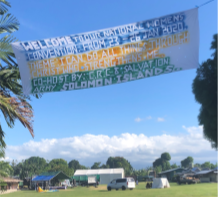
This was the scripture for the first Salvation Army District Women’s Bible Conference that was held on the 23rd - 26th January 2020.


In 2019 while talking with Mary Vasula, the local CRC pastor, we came up with the idea of having a combined conference with the aim of building up the women in our congregations. As we spoke together we realized that most of our women lacked confidence in themselves and their abilities. Many had grown up with the label of ‘pencil break’ (referring to those whose education has been broken) which is used in a derogatory way. Both Mary and I wanted to encourage our women and give them practical ways of knowing their confidence in Christ.


Our special guests for the weekend were Pastor Norma Cayzer, Turning Point CRC Senior Minister, and Pastor Joan Gordon. These ladies spoke throughout the conference and challenged the ladies to ‘Walk In Confidence’. The opening night was fantastic! The CRC youth opened the event with an amazing dance which incorporated the Solomon Islands flag. It was also where 200 women came together from all the different provinces to hear from the Word of God. Pastor Norma encouraged us to take a look at David and to ‘Press into God’ and that when we have troubles not to place our trust in people but in God.

Friday and Saturday mornings saw most of the campers up at 5:00 am for dawn prayer and then it was onto more teaching from Pastor Norma, Pastor Joan & myself. Topics covered included ‘Letting Go – Joseph’, ‘Intimidation – the Enemy of Confidence’, ‘The Names of the Lord’ and ‘Meditating on the Word of God’. Lunch was provided by The Salvation Army Emergency Services men which everyone enjoyed. After lunch there were electives that the women could attend which included ‘Children’s Ministries’, ‘Leading with Confidence’, ‘The World Needs You’, ‘Literacy’, ‘Reusable Sanitary Kits’, ‘Disaster Preparation’ provided by NDC, as well as the RSIPF representative Elizabeth Tavake providing an elective on ‘Family Violence’, which was one of the most well attended electives. I am aware that some women came forward and told Elizabeth that they were experiencing family violence and were needing help. Each of the campers came away from the electives chatting about what they had learned and how they could apply what they had learned to their everyday lives. This was exciting to hear as this was one of our desires, that women would learn different things that they would then apply.


The night sessions were amazing. The messages were ‘Stepping Up – Esther’ and ‘Being a Woman of Confidence’. After each message a group of ladies from the different churches represented put on items that ranged from dancing, singing and drama. It was fantastic not only to see the women come alive and step up in confidence but also to see the men from churches within Honiara that came to support their wives and daughters at the conference.


On Sunday morning as The Salvation Army Honiara Corps and Gateway CRC Church Henderson came together in worship with the campers, God was glorified. The singing was led by Francis which was God glorifying and extremely energetic with heaps of dancing. Pastor Norma spoke on ‘Rising Up – Deborah’.

Lunch was a ‘Motu’ (this is where food is placed on hot stones and are covered with banana leaves and left to cook) that was provided by the CRC Gateway ladies and youth. This was amazing and over 300 people enjoyed the food and the fellowship together. Yet, this was not the end. Sunday night was amazing. First, we spent time praising God and again hearing from His Word, which is where I challenged the ladies to not give up and reminded them of the Scripture that had been the basis of our weekend — “I can do ALL things through Christ who strengthens me”. After this it was definitely party time, where each group danced and sang and again the CRC youth and women closed the program with more amazing dancing.

The coming together of women from different parts of the Solomon Islands and from Australia was a true blessing and I am truly blessed to be part of the organizing committee that made this event come to fruition. I want to thank Mary and her team at CRC, Pastor Norma & Pastor Joan and The Salvation Army Emergency Services for their amazing contribution to the weekend.

Tuesday, October 1, 2019

Solomon Islands District - Father & Son Weekend

Family relationships in the Solomon Islands are defined by a complex blend of cultural and religious beliefs that have paradoxically created an environment where gender inequality is eroding the structure of Melanesian village life and deeply held biblical values. Consequently, Solomon Islands now has one of the highest rates of family and sexual violence in the world! Over the past two years we have seen the evidence of these statistics through disturbing regular RSIPF reports throughout Honiara and the Provinces, as well as through direct conversation and interaction with local men and women.

We have heard comments expressed by some of our men that suggest, “we are developing a spirit of retaliation in our homes” or “we don’t know how to interact with our sons.”  Many of our women have disqualified themselves from any role outside of domestic duties because of the label “pencil break” that they wear (meaning they are uneducated) and lament the lack of interaction between their husbands and children.  Our engagement with the RSIPF and NGO’s reveals how such comments are indicative of the vulnerability of families for destructive behaviours to manifest in their homes and village life.

This is the cultural and social context that led us to introduce the successful ‘Father & Son’ event run by The Salvation Army in PNG to the Solomon Islands District.  While there is a lot of work being done in the equality space with women, the need for such an event to change the thinking of men is very evident.  I firmly believe that ‘belief drives behavior’ so the Territorial theme for this year’s ‘Father & Son Weekend’ seemed pertinent for our context — ”Rise Up!  Men of Godly Character.” More than anything, Solomon Islands families need men who don’t just profess faith in God but whose character reflects the heart of God! 

The four messages that spoke into this theme over the weekend called on fathers and sons to be men of strong faith, men of pure heart, men of deep character and men of clear vision.  Our Territorial Commander, Colonel Kelvin Alley, was our invited guest speaker who spoke powerfully into each of these topics by drawing on the lives of Joseph, Hezekiah, David and Bartemaeus.


The Opening Session on Friday night set the tone for the weekend with an extraordinary time of worship led by the Honiara Corps Worship Team.  The evening also featured the RSIPF Brass Band who performed a bracket of contemporary music that was a clear crowd pleaser.  I had the privilege of playing flugelhorn alongside these very talented musicians and thoroughly enjoyed the opportunity. 

Saturday continued the teaching themes in morning and afternoon sessions, along with more opportunities for worship and response to the Word of God.   The day also included a fun and interactive activity to encourage the fathers and sons to work together and participate in some friendly competition.  We had the guys build ‘Billy Carts’.  This familiar activity growing up in Australia was completely foreign to Solomon Islands.  Nevertheless, once I displayed an image of a ‘Billy Cart’ on the screen and played the classic ‘pushcart race’ scene from the movie ‘Cool Runnings’, it didn’t take long for the men and boys to get excited and energetically participate in this activity.  I recruited the help of an Australian expat builder Martin Wynne, who provided the timber and his expertise. After a practice session at his workshop earlier in the week Martin captured the imagination of eight local builders who are a part of his work crew.  Such was their enthusiasm to get involved, they brought along their own ’Billy Cart’ and joined in our activity.

The fathers and sons were divided into four teams and allocated a prefabricated 
‘flat pack’ containing all the components to construct a ‘Billy Cart’. Team leaders guided the process to ensure each ‘Billy Cart’ was race worthy. It was terrific to see the level of participation by the guys of all ages and the energy they invested into constructing their team ‘Billy Cart’. While the concept of a ‘Billy Cart’ was initially unfamiliar, nobody had to show them what to do with the finished product! After lunch, which was lovingly prepared by the wives and mothers of those who attended the weekend, the inaugural Solomon Islands District Billy Car Race was on! Each team was assigned a coloured bandana and the friendly laughter immediately turned to some seriously competitive cheering as the first round of drivers and runners lined up at the starting line. There were multiple thrills and spills as the ‘Billy Carts’ weaved around the figure of eight course. In such a competitive environment there were the inevitable scrapes requiring some minor first aid and missing wheels requiring mechanical attention from the pit crew. After several rounds somebody had the idea to hold a ‘leaders’ race. So, the Territorial Commander, District Officer, Honiara Corps Officer and Gateway Corps Officer took their positions on the starting line. The TC had a commanding lead after the first lap as the DO took the inside curve on the final bend to steal the lead when his ‘Billy Cart’ became entangled with the TC. Then, out of nowhere the Honiara CO did a “Steve Bradbury” winning the race from behind, with the Gateway CO on his tail for a close second. It was a lot of fun, though the TC is calling for a rematch! The value of this activity was much more than a lot of fun and laughs. It was great to see the interaction between fathers and sons, the coaching as guys learned new skills and the team spirit on the racetrack. From the youngest to the oldest, everybody got involved and by the end of the day, everyone wanted one of the ‘Billy Carts’. The TC made a great suggestion to hold a silent auction to fairly allocate the four ‘Billy Carts’, which solved a potentially tricky situation. Though, I’m tipping a few backyard projects are sure to follow for those who missed out.


Each teaching session commenced with a fun 
activity to further engage the fathers and sons with each other and the theme for the weekend.  The first was a game of ‘Celebrity Heads’ to challenge the guys, with the help of the audience, to guess which biblical father and son they had displayed on their head.  The second involved an enactment of the rite of passage for young men of shaving.   It was hilarious watching the brave dadi’s allow their pikinini to shave their faces, albeit with a plastic knife.  On the Saturday evening, the Closing Session featured some of the Honiara Corps youth who are a part of a local band they call the “Holy Cross Boys.”  Their style of music is a blend of country rock and gospel with a Bon Jovi vibe (especially when Solomon is singing).  These talented young men added a pleasing musical contrast to Friday night’s featured band that was equally enjoyed by the congregation.  The Territorial Commander concluded the final session with a call to commitment that invited the men and boys to sign the following declaration:

“In the presence of God who loves me, who has called me, and who has promised to always be with me, I commit my life by God’s grace, to be a Man of Godly Character in my family, my village and my country.  I choose today, and by God’s help to be the Man of Godly Character that He has called me to be.”


On Sunday morning the whole Honiara Corps congregation came together for a combined time of worship at the Father & Son venue as a finale to the weekend.  This service was a celebration of a powerful couple of days together and included two very significant Salvation Army ceremonies—the Enrolment of two Soldiers and the Commissioning and Appointment of six Envoys.  This was truly a momentous occasion for the Solomon Islands District!  Alick and Esther Hagi started attending The Salvation Army in Honiara after the National General Election in April this year.  They are from a Church of Nazarene background, where Alick had previously held ministry credentials as a Pastor.  His credentials were taken from him by church leadership after he unsuccessfully contested the election in their constituency, so they decided to look for a church where he could continue to serve.  Alick and Esther have a heart for mission and easily aligned with the theology and mission of The Salvation Army.  It has been a pleasure watching their growth and engagement at the Honiara Corps over the past few months. Alick works at the Solomon Islands National University (SINU) and has opened up a number of ministry opportunities already, including the idea of commencing a new Neighbourhood Fellowship on the SINU campus.

The Commissioning of new District Envoys and the official recognition of their appointments was truly a significant moment for the Solomon Islands District.  We have been working hard over the past two years to raise up local leaders, so it brought us much joy to witness Territorial recognition of these leaders.  The rank of Envoy has been applied in this situation as two of the couples are above the maximum age to enter the Officer Training College (OTC), while the other couple is presently navigating through the Nominee/Candidate process for training at the OTC.   The formal recognition of their roles lays a foundation of official Salvation Army leadership in our District that will encourage others to rise up and respond to God’s calling to become Salvation Army Officers.  We congratulate Envoys Wency & Fostina Ramo’oroa on their appointment as Corps Officers of Honiara Corps, Envoys Charles & Judith Akwasitaloa on their appointment as the Corps Officers of Gateway Corps, and Envoys Joshua Henry & Edith Aebata on their appointment as the Area Officers of Malaita Province.   Colonel Julie gave an appropriate message for the occasion, referencing William Booth’s image of ‘A Vision of the Lost’ to challenge the congregation not to get too comfortable on the ‘rock’ but to reach out and rescue those who are still perishing.

Following the service, Major Vanessa presented Colonels Kelvin & Julie with a gift of appreciation on behalf of the District for their leadership of the Papua New Guinea & Solomon Islands Territory.  This will be their last visit to the Solomon Islands before retiring next year.  Their support and encouragement have been deeply appreciated by Vanessa and I as well as the Salvationists who make up this growing mission in the Solomon Islands.

Our first Father & Son Weekend was a great success with God speaking so powerfully into the lives of those who attended and affirming His mission in the Solomon Islands.  We would like to extend our sincere appreciation to our guest leaders Colonels Kelvin & Julie Alley, the RSIPF Band, the Holy Cross Boys, the ladies of our SAES team and Martin Wynne for contributing to the success of this weekend.

Friday, September 27, 2019

Holy Land Pilgrimage Journal (Day 16)

Friday, 27th September 2019


When we flew into Brisbane, we ordered a ride through ‘Uber’ to get from the international terminal to the motel. To our surprise, the driver was a Jordanian man who had grown up in Bethlehem in the West Bank. He also worked in Dubai before moving his family to Australia. He was so excited that we had just travelled to his homeland. We shared stories about the places we had visited and learned a bit about his family during the short trip to the motel. It really was a delightful way to end this part of our trip back to Australia. What are the chances of getting a driver from Jordan and the West Bank in Brisbane?!


Thursday, September 26, 2019

Holy Land Pilgrimage Journal (Day 15)

Thursday, 26th September 2019


Today’s journal entry comes from the seat of flight EK904 from Amman to Dubai, as we begin our journey home. We left the Movenpick Hotel in Petra early to make our way up to Amman. Along the way, we stopped at Mount Nebo to visit the ‘Memorial of Moses’. From this vantage point, we looked over the Jordan Valley and could see what Moses did from the very spot that God gave Moses a glimpse of the land he would never enter. It was a surreal moment taking in the significance of such a view. It was so much more than just pretty scenery but a vision of a promise for the people of Israel.

“Then Moses climbed Mount Nebo from the plains of Moab to the top of Pisgah, across from Jericho. There the Lord showed him the whole land – from Gilead to Dan, all of Naphtali, the territory of Ephraim and Manasseh, all the land of Judah as far as the Mediterranean Sea, the Negev and the whole region from the valley of Jericho, the City of Palms, as far as Zoar. Then the Lord said to him, “This is the land I promised on oath to Abraham, Isaac and Jacob when I said, “I will give it to your descendants.” I have let you see it with your eyes, but you will not cross over into it”” (Deuteronomy 34:1-4).

What may have been a disappointment to Moses may also have been a vision of fulfilment, having completed the task God assigned to him at the burning bush. We don’t read of disappointment or resentment but of anointing and handing of the mantle of leadership to Joshua to lead the Israelites Moses had rescued from slavery into the promised land.

“Now Joshua son of Nun was filled with the spirit of wisdom because Moses had laid his hands on him. So the Israelites listened to him and did what the Lord had commanded Moses.” (Deuteronomy 34:9)

The ‘Memorial Church of Moses’, along with some impacting statues, stand as a tribute to the man who earned the epitaph, “Since then, no prophet has risen in Israel like Moses, whom the Lord knew face to face…” (Deuteronomy 34:10). The remains of the 6th century church and stunning mosaics housed in this memorial church have stood as a lasting testimony to Moses’ life and leadership on top of Mount Nebo.

From the mountaintop we descended back down into the valley to the city of Madaba to visit ‘St. George’s Mosaic Map Church’. This remarkable mosaic map of the Holy Land and surrounding regions is another example of the amazing craftsmanship of the 6th century that has been passed down through the generations to today in Jordan. The detail of this map, showing key places of biblical significance, is something to be admired and preserved for future generations.

After visiting the ‘Church of the Mosaic Map’ we all gathered at the 'Haret Jdoudna Restaurant' for our final meal together as a group of pilgrims. Over the past two weeks, we have shared a life changing pilgrimage that has taken us on a journey through the pages of Scripture to the sites where it actually happened. We have shared moments of awe and wonder, laughed and cried together, and have experienced divine encounters along the way. At the beginning of this pilgrimage, many of us were strangers, but along the way, a bond of friendship that has roots sown in a mutual experience has been formed. As we each return to our respective appointments, we will take a piece of each other’s lives with us as fellow pilgrims of the Holy Land. It has been a real joy to share this journey with Officers from around Australia that already share a common calling and covenant. It has also been a delight getting to know Officers from the former Australia Eastern Territory and travel together under the banner of the new Australia National Territory.

As we approached Amman airport in Jordan, one of our fellow pilgrims presented us each with a small crocheted cross that she had handmade during our trip as a thoughtful token of our journey in the footsteps of Jesus over the past two weeks. Therefore, I have chosen to embed this lovely gift into the pages of this journal as a permanent imprint of what this trip was all about. It’s all about Jesus!! The historic Greco-Roman culture set the environment for the birth of Jesus and the present Israel Palestinian conflict may well set the scene for the return of Jesus. In the centre of this complex political and religious region, by God’s divine providence, Jesus still remains at the heart of the Holy Land. The ‘Wailing Wall’ and the ‘Golden Dome’ pale into insignificance before the path of the cross! Even the ornate beauty of the ‘Holy Sepulchre’ falls short of the majesty of the One it represents. Walking in the ‘Footsteps of Jesus’ throughout the Holy Land was ultimately a journey towards the cross, as this was Christ’s mission for the salvation of humankind. All His teaching, miracles and encounters along the way was to fulfil His Father’s will (John 6:38).

“Oh, the wonderful cross, oh the wonderful cross
Bid me come and die and find that I may truly live.

Oh, the wonderful cross, oh the wonderful cross
All who gather here by grace, draw near and bless Your name.

Love so amazing, so divine demands my soul, my life, my all.
It’s the beauty and the shame, it’s the glory and the name
Wonderful cross.”

Wednesday, September 25, 2019

Holy Land Pilgrimage Journal (Day 14)

Wednesday, 25th September 2019


Our destination for today was literally over the road from our hotel. The visitor centre at the Petra Archaeological Park was a doorway to one of the ‘7 Wonders of the World’. As we descended the stony path, we were greeted by stunning sandstone cliffs that gradually revealed their secrets. This was the land of the Nabateans who carved extraordinary monuments into the surrounding cliffs to form a sophisticated society in the barren desert. Elaborately decorated rock faced tombs of the Nabateans and caves recently occupied by the Bedouins line the cliff faces. Following the contours of the ‘Siq’ (shaft) is an aqueduct channel carved into the sandstone to allow a channel of water to run down the mountain into deep cisterns to sustain this ancient civilisation in the desert. Walking through this crevice known as the ‘Siq’ was an awe-inspiring experience and a photographer’s paradise! 

Every turn opened up another stunning scene begging to be photographed. The natural colours of the sandstone against the bright blue sky with the sun piercing between the rocks was truly amazing. The further we descended the more impressive the tomb carvings became. Then we reached the famous ‘Treasury’ which was featured in the movie ‘Indiana Jones – Last Crusade’. This forty metre high façade carved into the cliff face is a magnificent, intricate rock craving from the first century that has been remarkably preserved to the present day.

Beyond this main attraction, we found the ‘High Place of Sacrifice’, a Roman style theatre that can seat 4,000 spectators, royal tombs, the church and other equally spectacular world heritage monuments from this ancient city. There was so much to take in along this promenade of historic masterpieces. Along the way, were peddlers, market stalls, donkey and camel rides and other conveniences for the large number of tourists who visit this attraction. Unlike the locations we have visited throughout this trip, the locals trying to sell their products or services actually added to the experience. It brought these static displays to life with the hustle and bustle of village life that gave some sense of how this society may have functioned. You could almost imagine the travelling caravans passing through the once vibrant community. In fact, it was just outside of Petra where Moses struck the rock (Numbers 20:7-11) when the Israelites were perishing from thirst in the desert. It is said that Moses sent a message to King Rekem of Petra, asking permission to pass through Edom, but the king refused causing Moses and the Israelites to take the longer route around this valley. Maybe the king’s refusal was to preserve the precious water he had stored up in their cisterns? This land is full of stories that could take a lifetime to uncover. Today’s adventure certainly raised my curiosity and interest to learn more about this fascinating place that I walked through today.

When we returned to the visitor centre this afternoon, we were looking for a souvenir for our son Adam, which led us to this small store where we met the owner Magid. His shop was without power, which opened up a conversation that went well beyond us spending a few ‘Dina’ in his shop. Magid shared his heart and soul with us, revealing the very dark place of hopelessness he was in and his feeling of despair. We were deeply moved by his story but felt somewhat helpless as we will probably never see him again when we leave Jordan tomorrow. So, I felt prompted in my spirit to promise him that we would pray for this Muslim man from Petra. I asked his permission to take his photo as a reminder for me to fulfil my promise. He seemed somewhat uplifted by this commitment of prayer and asked us to start praying tonight, as he is presently trying to sell some land. He was so grateful for this conversation that he refused to take my money for our purchase and even broke Muslim protocol by reaching out to shake Ness’ hand. He said, “I don’t normally shake the hand of a woman, but there is something different about you.” We left his shop feeling this was a God-ordained encounter and with a sense that His Spirit was present in this encounter.

After dinner, our group assembled for a final time of devotion together. Our leaders Graham led a time of sharing about the highlights of this pilgrimage. After two weeks of travelling the Holy Land, there was much to share; so many experiences, divine encounters, ‘aha’ moments that impacted each one of us in different ways. Yet, something I believe we all share in common is that we will return to our respective appointments different people to who we were before we embarked on this pilgrimage. With just one day left before we depart Amman tomorrow night, we have so much to give thanks for – to God first, and to The Salvation Army for granting us this opportunity.